

- Inspirational
- News
- 04 Oct 2025
Why Modern Trading Needs Multiple Approaches
Today, the share market is faster, wiser, and more competitive than ever. Specifically, there is information available in real-time, and there are thousands of traders eyeing the same opportunity. Thus, you may want to adjust your trading style since only using one trading strategy is no longer probably sufficient. Today’s successful traders use an integrated approach that involves using each of the following strategies together: medium-term directed plays, short-term momentum, and automated trading, all while applying a bunch of good old-fashioned trading discipline. By not relying on just one trading strategy, you increase your ability to seize opportunities, better manage your risk, and develop a longer-term competitive advantage in stock market trading.
Momentum Trading
When speed and strength are in your favor, momentum trading is the way to go. This trading style looks at stocks that are moving quickly in one direction (often from news, earnings, or from overall market sentiment). Traders jump in and ride the wave in the stocks and quickly get out when the momentum slows.
-Example: If a company reports earnings that are better than expected, it may have one day in which it has a 10% gain. Momentum traders enter the stock early to catch this quick move.
-Why it works: Momentum trading is effective because it takes advantage of the psychology of the market. Fear and greed can push prices faster than fundamentals.
-Difference to swing trading: Momentum is short term aggressive style trading that is mainly concentrated on speed and immediate strength. Swing trading is focused on staying in the game and waiting long enough for a larger price wave to go in your favour.

Swing Trading
Swing trading seeks to capture price action waves that last a couple of days to weeks. Swing traders will look for chart patterns, support and resistance levels, and technical indicators to find their entry and exit points. Instead of trading every tick in a live stock market, swing traders work to “ride their trends” patiently until their move is finished.
-Example: A stock that has been trending up over the past two weeks will have several entry points for swing traders to enter trades based on chart patterns like a flag or triangle pattern.
-Why it is important: Swing trading strategies can allow traders with screen time constraints the opportunity to navigate the markets with a reduced level of noise from the short-term volatility.
-What is the difference between swing trading and other styles of trading: Swing trading is neither faster nor slower than other styles of trading or investing. Although swing traders are not concerned with speed like momentum traders, swing traders still need to capture ‘medium-term’ moves which work much faster than long-term investing.
Algo Trading/Rule-Based Trading
Trading is now being transformed by technology, and algo or automated trading is the leader of that transformation. Algorithmic trading can execute trades for you when the rules you have set are triggered. The goal of algo trading is to take away the emotional side of trading and allow you to react faster than human traders.
-Benefits of Algo Trading: Instant execution without delay, back-tested strategies remove guesswork work and the ability to track multiple stocks at once.
-Why this matters: Algo trading is no longer meant just for institutions. The advancement of platforms from technological advances is making them retail friendly. This allows retail and small investors to auto-trade portions of their trading strategies. Think of sites like small case or even demo trading platforms that enable traders to practice before hitting the live button.
-Difference from manual styles: Algorithmic trading takes away emotion completely and relies on pure data-driven rules as opposed to swinging and momentum, which requires solely manual trading.
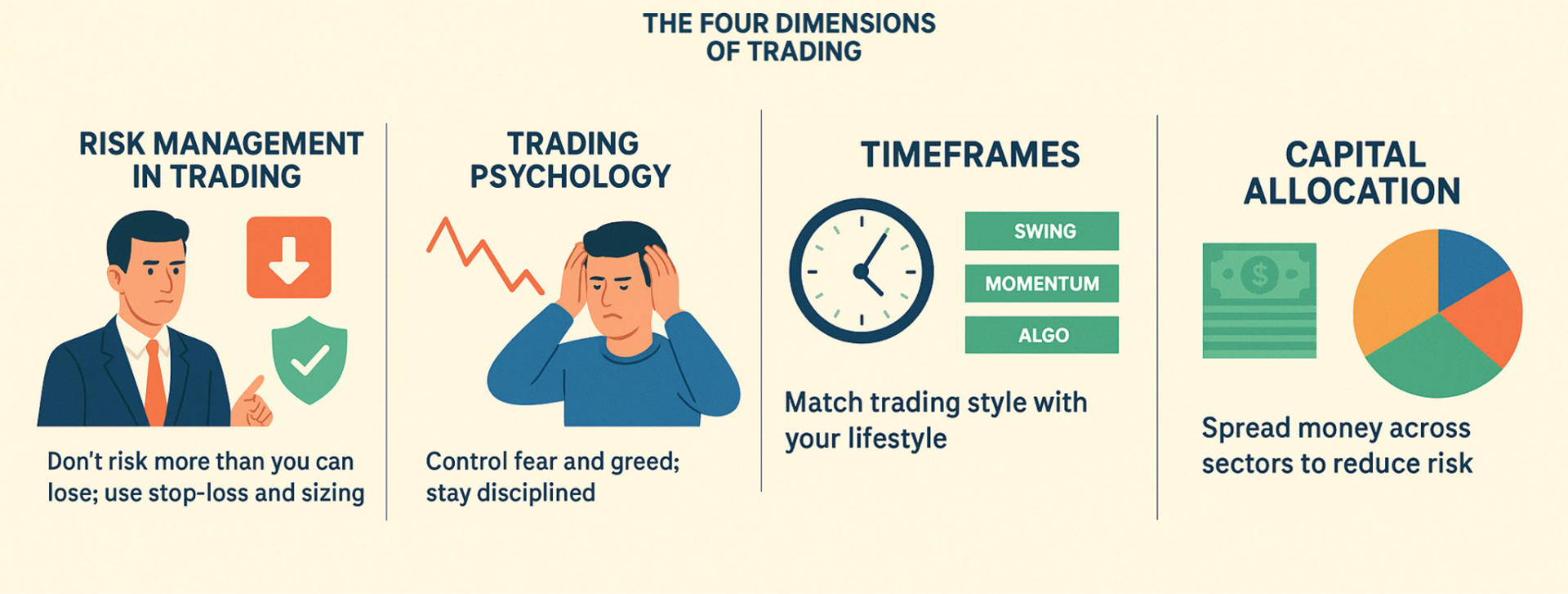
The Four Dimensions of Trading
No matter which style you choose, whether it be swing, momentum, or algo trading, you can’t truly succeed in the share market without understanding the four dimensions of trading:
1. Risk Management in Trading – Don’t risk more than you can afford to lose. Stop-loss orders and position sizing protect capital.
2. Trading Psychology – Fear and greed make us impulsive. Discipline allows for consistency.
3. Timeframes – Make sure that the timeframes are consistent with your lifestyle. Swing trading is appropriate for a medium-term strategy, momentum trading is focused on the short-term, and algo trading can be either short or medium-term strategy.
4. Capital Allocation – Distributing capital to different sectors or methods reduces dependency on a sector or method and balances out risk.
These dimensions form the foundation for sustainable stock market trading.
Conclusion
The best traders in our current environment do not just follow one style. They have combined swing trading and move tactics for medium-term trades, while momentum trades and, algo trades for the shorter moves. All this is in conjunction with risk management, trading psychology indicators, and capital allocation. This covered approach creates the winning edge in trading. Trading on a demo account or watching the stock market live… remember, trading is not one strategy or style fitted to a market. It is the combination of effort to accommodate changes in the market.
Success in trading will not come from getting into the latest hot stock or following tips blindly. Success will come from diversification, discipline, and the combination of strategies mentioned before. When combined correctly in hidden work in the shadows of the four dimensions of time, price, space, and sentiment, with some expectations, you can definitely create a long-term balanced plan to win at share markets.
“If you are serious about integrating these strategies into your own, your fast track learning will be to undertake a course with a SEBI-registered research analyst. These training sessions will give you a qualified experience of the market trading environment where you can practice safely and build the discipline you need to trade smartly in the share market.”
Leave a Reply